Resonance of Ki (氣,
Energy)
Yoon
Jin Sup(Art Critic)
Park Daa Won visualizes the vitality of life with
one bold and skillful stroke with her new body of works in her a solo
exhibition. This exhibition is to show her unique works she painted with
spontaneous and intuitive lines in the state filled with energy as if she
practiced Zen with all her Ki (氣,
energy) and spirits. This exhibition is significant in a lot of senses in light
of the Dansaekhwa (monochromatic
paintings) movement popular at home and abroad.

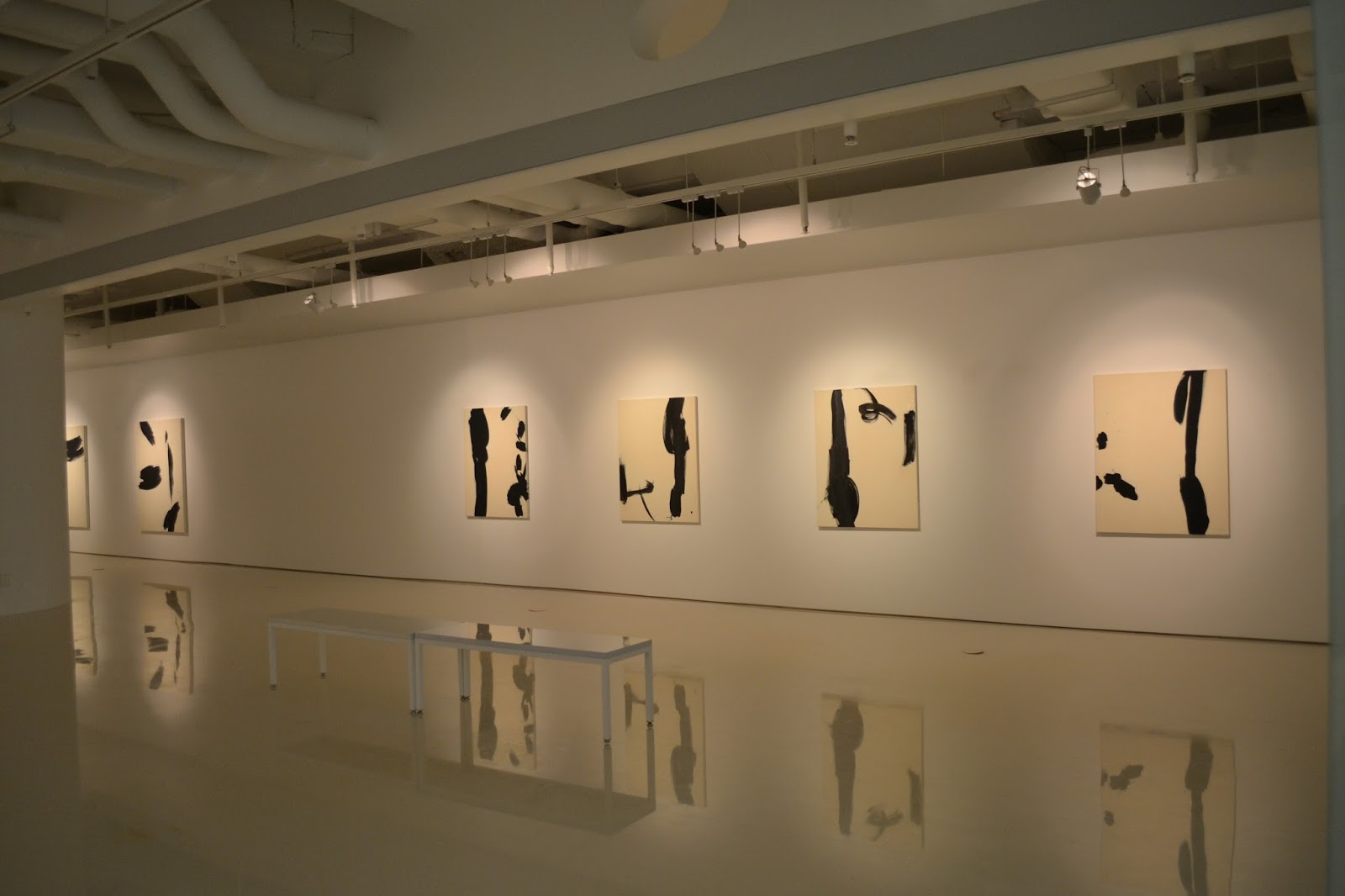
Art of Tansaekhwa /Nowhere in Blue / Park Daa won
Park’s bold strokes runnning on light beige or dark
blue planes on wide canvases are based on the One-Stroke Theory coined by the
Chinese artist and philosopher of painting, Seok-do. One-Stroke Theory aims to ultimately
reach ‘a pure state of primitive essence.’ In other words, the artist’s stroke
reveals a longing for ‘the un-scattered state of nature in its primitive form.’
In this perspective, Seok-do claims, ‘One stroke is the basis of ten thousand
strokes and ten thousand shapes.’ The fact that Seok-do’s philosophy is sought
after in contemporary paintings - in conjunction with issues on artificial
intelligence - points to contemporary artists who insist on the technique of
single strokes, like Park Daa Won. In short, Park is an artist who persists on the
analog method of creation in digital times. Thus, it can be presumed that Park
had a strong sense of purpose in her decision and praxis of One-Stroke Theory. Consider
the following texts disclosed from Park’s artist notes:
“When I begin with my strokes, I pray for
time, space and history of the universe; for God’s presence and His love. I
hope to share these sentiments with anyone who looks at my paintings.”

Art of dansaekhwa / Now here / Park Daa Won

Art of dansaekhwa / Now here / Park Daa Won
Art is a way of expressing the mysterious rules of
the universe with a single stroke or a dot. Park Daa Won’s statement may appear
rather grandiose, but it includes her vision of the universe or her perspective
of time, space and history. The artist realizes her artistic intuition through
her body of works. At times, the empty canvas may appear as an object of terror
for an artist. The entirety of these ideas act as a metaphor of the Great Void,
also known as the universe in its primitive form. In this sense, the
two-dimensional planes covered in sun-bathed hues of beige (Now Here series), structural
hues of brown (Becoming series), or universal hues of blue (Now Here in Blue
series) may all be considered as a metaphor of the universe at large.
Therefore, Park’s one-stroke painting with her single-color brush embodying all her energy signifies the primitive act of creating ripples of energy into the uninhabited vacuum of the universe. If such energy is regarded as the concentration of the artist’s Ki collected from the body, the act of translating Ki onto the canvases can be observed as a primitive form of artistic gesture. Park’s employment of the brush is an artistic event occurring on canvas, much like the cosmic event widely known as the Big Bang. Although the scope of her artistic endeavors is limited to the canvas, it may also be defined as the performance of body.
Therefore, Park’s one-stroke painting with her single-color brush embodying all her energy signifies the primitive act of creating ripples of energy into the uninhabited vacuum of the universe. If such energy is regarded as the concentration of the artist’s Ki collected from the body, the act of translating Ki onto the canvases can be observed as a primitive form of artistic gesture. Park’s employment of the brush is an artistic event occurring on canvas, much like the cosmic event widely known as the Big Bang. Although the scope of her artistic endeavors is limited to the canvas, it may also be defined as the performance of body.

Art of Tansaekhwa /Nowhere in Blue / Park Daa won
Park Daa Won’s paintings do not leave room for modification
or repainting, which means that the act of making a single stroke also defines
completion. In other words, the act of repainting negates the very notion of
completion, as this very act equates to the acceptance of the artist’s failure
to attain perfection. This illuminates the fact that the chances of failure for
perfect completion of Park’s work is very high. However, considering the
artist’s exceptional level of standards for perfection, one may assert with
confidence that the works displayed in this exhibition are works completed with
outstanding quality.
Park Daa Won’s act of painting aims to emulate the
primitive state of the world - the Great Void. This may also relate to the
state of chaos or the state of total darkness as mentioned in the book of
Genesis in the Bible and the Great Ultimate in the Book of Changes (周易).
In Knowledge Wanders North (知北遊篇), Chinese philosopher Zhuangzi
(Chuang-Tzu) engaged this expression to convey that the ‘intangible’ source of
the world, as drawn from the ancient philosophy of Taoism(道).
The monochromatic canvas set forth by the artist represents a physical
phenomenon; but it also serves as a medium that triggers psychological events
such as tranquility or terror. The subjects to be translated onto canvas are
chosen entirely by the artist. Depending on the artist’s capacity, the empty space
may become a product of meaninglessness or end up as a psychological event. This
likens to what we know as Jackson Pollock’s act of dripping technique - an
artistic phenomenon taken place outside of the typical canvas-on-easel
technique – which was to become an artistic phenomenon to go down in
history.

Art of Tansaekhwa /Now here -Beoming / Park Daa won
Park Daa Won’s painting technique can be surmised as
an act of inspiration, breathing meanings onto the empty canvases through a
single stroke without leaving room for repainting. The act of waiting is
compulsory in this process. Once an idea is conceived, the next step is to
collect Ki, energy in its preliminary
stage. When Ki is collected, the
artist approaches the canvas with a brush dipped heavily in one color followed
by the controlled breathing in line with the intuitive employment of brush
strokes. Therefore, the discursive process of collecting Ki and the intuitive conception of these psychological events are
all part of what appears to be a shorter counterpart and the final act of brush
strokes. These are substantial reasons to regard Park Daa Won’s unique way of
creation as an act of performance.
In the end, such creative methods interpreted as
acts of performance, may also be read as an effort to realize the rules of
nature associated with life. The rules of nature such as the rhythmic strengths
and weaknesses of lines, and controlled breathing in relation to span of time,
life and death of creatures, movements of space, and cyclic changes of seasons
and so on are all visualized through extremely reductive acts. Park Daa Won’s monochromatic
paintings, therefore, have meanings of setting back events through reductive
and primitive acts. At this point, the events refer not to physical phenomenon,
but to cultural ones. In that not many of countless events on the canvases have
meanings, the performance of body by Park Daa Won is based on the fact that it
has its own meaning as a one-time event. Unfolding his theory on the game of Go,
Lee Ufan once put that when he places a stone on the Go board, tension spreads throughout
the entire board; and such is the case with Park Daa Won.

Art of Dansaekhwa / Now here / Park Daa Won
Park Daa Won’s works start with drawing a line with
a brush dipped in single-color paint onto the under painted canvas. The stroke
created at this point is made by intuition accompanied by incidental effects of
paint splashed or dripped in the process. Sometimes split brush brings about
rough coats and runs. Such traces of brush constructs incidental effects within
the given frame. This is also the point when Ki springs up. The flow of Ki
transferred from the tranquil state of contemplation where the mind has
achieved peace, sometimes in its intense and sometimes in its simple form, is
translated onto the canvas in its purest and primitive form by the ends of the
brush. I have had the privilege to
expound on the resonance of Ki in Park’s solo exhibition not long ago.
‘Park Daa Won’s paintings are statements of
resonance revealed by touches of brushes. How are touches of brushes resonant?
Is it possible to introduce this word which shows auditory effects to form?
When a brush encounters the surface of a plane and finally parts with it, I see
its traces remaining on the canvas. It is as if the traces of replica have
disappeared yet seems to wander about somewhere else. A silent event which
occurred ‘now and here -hic et nunc’ sets off a silent echo like a wavelength
of a ripple. A dot and a line drawn on the canvas brings about silent waves. Park’s
paintings are a statement of resonances echoed by touches of brushes manifested
by the dots and lines on the space of a canvas.’

Art of Tansaekhwa / Now here / Park Daa Won
I wanted this essay to
be titled as “Resonance of Ki(氣).” How does Ki
resonate? First of all, Ki is the
state of being alive. It implies the ‘vital impetus (élan vital)’ by Henri
Bergson, which means that life is in present continuous state, in an endlessly
moving form. I exist Now Here (the integrated state of the
past, present and future); and thus as an existential being, I (the artist) transfer
onto the canvas the vivid experiences of my life. At this point, the essence of
life projected onto the canvas extends outwards to the larger world through the
appreciation of the viewers. Such chain of these benefits may be identified as
‘Resonance of Ki.’