Wikipedia

Search results

Showing posts with label monochrome abstraction. Show all posts

Thursday, November 3, 2016

Art of Dansaekhwa / Resonance of Ki (氣, Energy)

Resonance of Ki (, Energy)

                                         Yoon Jin Sup(Art Critic)

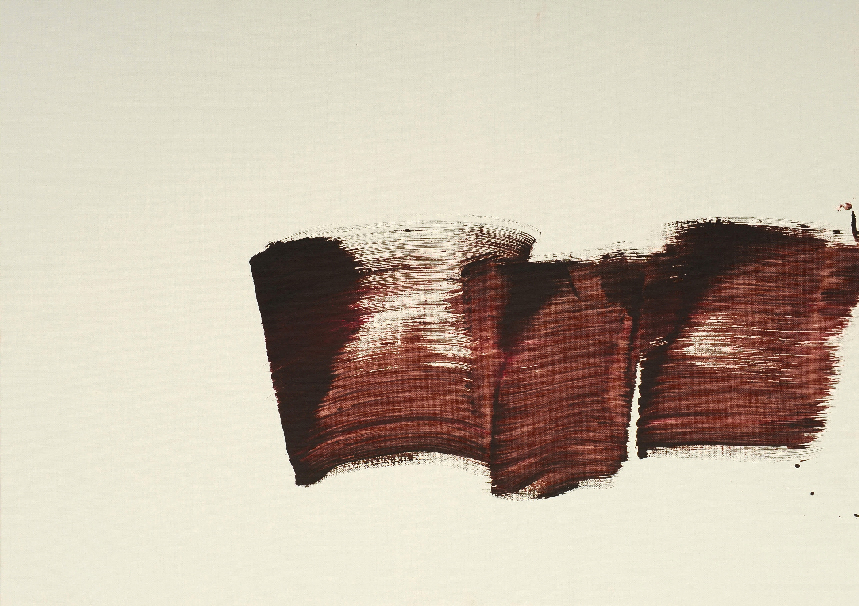
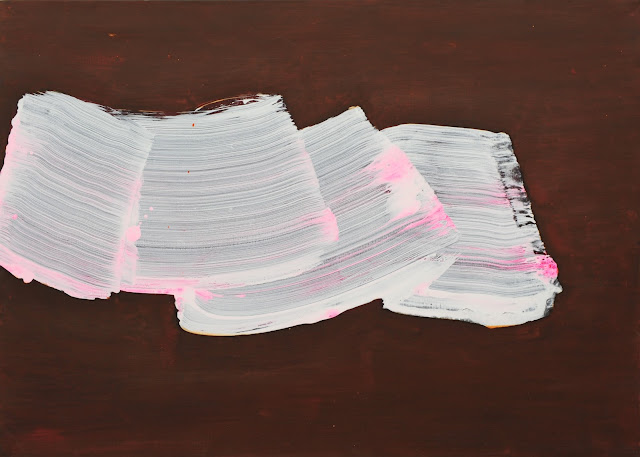
 Park Daa Won visualizes the vitality of life with one bold and skillful stroke with her new body of works in her a solo exhibition. This exhibition is to show her unique works she painted with spontaneous and intuitive lines in the state filled with energy as if she practiced Zen with all her Ki (, energy) and spirits. This exhibition is significant in a lot of senses in light of the Dansaekhwa (monochromatic paintings) movement popular at home and abroad.


     Art of Tansaekhwa /Nowhere in Blue / Park Daa won

                  Park’s bold strokes runnning on light beige or dark blue planes on wide canvases are based on the One-Stroke Theory coined by the Chinese artist and philosopher of painting, Seok-do. One-Stroke Theory aims to ultimately reach ‘a pure state of primitive essence.’ In other words, the artist’s stroke reveals a longing for ‘the un-scattered state of nature in its primitive form.’ In this perspective, Seok-do claims, ‘One stroke is the basis of ten thousand strokes and ten thousand shapes.’ The fact that Seok-do’s philosophy is sought after in contemporary paintings - in conjunction with issues on artificial intelligence - points to contemporary artists who insist on the technique of single strokes, like Park Daa Won. In short, Park is an artist who persists on the analog method of creation in digital times. Thus, it can be presumed that Park had a strong sense of purpose in her decision and praxis of One-Stroke Theory. Consider the following texts disclosed from Park’s artist notes:   
 “When I begin with my strokes, I pray for time, space and history of the universe; for God’s presence and His love. I hope to share these sentiments with anyone who looks at my paintings.”
                  Art is a way of expressing the mysterious rules of the universe with a single stroke or a dot. Park Daa Won’s statement may appear rather grandiose, but it includes her vision of the universe or her perspective of time, space and history. The artist realizes her artistic intuition through her body of works. At times, the empty canvas may appear as an object of terror for an artist. The entirety of these ideas act as a metaphor of the Great Void, also known as the universe in its primitive form. In this sense, the two-dimensional planes covered in sun-bathed hues of beige (Now Here series), structural hues of brown (Becoming series), or universal hues of blue (Now Here in Blue series) may all be considered as a metaphor of the universe at large. Therefore, Park’s one-stroke painting with her single-color brush embodying all her energy signifies the primitive act of creating ripples of energy into the uninhabited vacuum of the universe. If such energy is regarded as the concentration of the artist’s Ki collected from the body, the act of translating Ki onto the canvases can be observed as a primitive form of artistic gesture. Park’s employment of the brush is an artistic event occurring on canvas, much like the cosmic event widely known as the Big Bang. Although the scope of her artistic endeavors is limited to the canvas, it may also be defined as the performance of body.


      Art of Tansaekhwa /Nowhere in Blue / Park Daa won

                  Park Daa Won’s paintings do not leave room for modification or repainting, which means that the act of making a single stroke also defines completion. In other words, the act of repainting negates the very notion of completion, as this very act equates to the acceptance of the artist’s failure to attain perfection. This illuminates the fact that the chances of failure for perfect completion of Park’s work is very high. However, considering the artist’s exceptional level of standards for perfection, one may assert with confidence that the works displayed in this exhibition are works completed with outstanding quality.  
Park Daa Won’s act of painting aims to emulate the primitive state of the world - the Great Void. This may also relate to the state of chaos or the state of total darkness as mentioned in the book of Genesis in the Bible and the Great Ultimate in the Book of Changes (周易). In Knowledge Wanders North (知北遊篇), Chinese philosopher Zhuangzi (Chuang-Tzu) engaged this expression to convey that the ‘intangible’ source of the world, as drawn from the ancient philosophy of Taoism(). The monochromatic canvas set forth by the artist represents a physical phenomenon; but it also serves as a medium that triggers psychological events such as tranquility or terror. The subjects to be translated onto canvas are chosen entirely by the artist. Depending on the artist’s capacity, the empty space may become a product of meaninglessness or end up as a psychological event. This likens to what we know as Jackson Pollock’s act of dripping technique - an artistic phenomenon taken place outside of the typical canvas-on-easel technique – which was to become an artistic phenomenon to go down in history.  

  Art of Tansaekhwa /Now here -Beoming / Park Daa won

Park Daa Won’s painting technique can be surmised as an act of inspiration, breathing meanings onto the empty canvases through a single stroke without leaving room for repainting. The act of waiting is compulsory in this process. Once an idea is conceived, the next step is to collect Ki, energy in its preliminary stage. When Ki is collected, the artist approaches the canvas with a brush dipped heavily in one color followed by the controlled breathing in line with the intuitive employment of brush strokes. Therefore, the discursive process of collecting Ki and the intuitive conception of these psychological events are all part of what appears to be a shorter counterpart and the final act of brush strokes. These are substantial reasons to regard Park Daa Won’s unique way of creation as an act of performance.
    
 In the end, such creative methods interpreted as acts of performance, may also be read as an effort to realize the rules of nature associated with life. The rules of nature such as the rhythmic strengths and weaknesses of lines, and controlled breathing in relation to span of time, life and death of creatures, movements of space, and cyclic changes of seasons and so on are all visualized through extremely reductive acts. Park Daa Won’s monochromatic paintings, therefore, have meanings of setting back events through reductive and primitive acts. At this point, the events refer not to physical phenomenon, but to cultural ones. In that not many of countless events on the canvases have meanings, the performance of body by Park Daa Won is based on the fact that it has its own meaning as a one-time event. Unfolding his theory on the game of Go, Lee Ufan once put that when he places a stone on the Go board, tension spreads throughout the entire board; and such is the case with Park Daa Won.  


      Art of Dansaekhwa  /  Now here  /  Park Daa Won
                  
Park Daa Won’s works start with drawing a line with a brush dipped in single-color paint onto the under painted canvas. The stroke created at this point is made by intuition accompanied by incidental effects of paint splashed or dripped in the process. Sometimes split brush brings about rough coats and runs. Such traces of brush constructs incidental effects within the given frame. This is also the point when Ki springs up. The flow of Ki transferred from the tranquil state of contemplation where the mind has achieved peace, sometimes in its intense and sometimes in its simple form, is translated onto the canvas in its purest and primitive form by the ends of the brush.  I have had the privilege to expound on the resonance of Ki in Park’s solo exhibition not long ago.


    ‘Park Daa Won’s paintings are statements of resonance revealed by touches of brushes. How are touches of brushes resonant? Is it possible to introduce this word which shows auditory effects to form? When a brush encounters the surface of a plane and finally parts with it, I see its traces remaining on the canvas. It is as if the traces of replica have disappeared yet seems to wander about somewhere else. A silent event which occurred ‘now and here -hic et nunc’ sets off a silent echo like a wavelength of a ripple. A dot and a line drawn on the canvas brings about silent waves. Park’s paintings are a statement of resonances echoed by touches of brushes manifested by the dots and lines on the space of a canvas.’


       Art of Tansaekhwa  /  Now here  /  Park Daa Won

I wanted this essay to be titled as “Resonance of Ki().” How does Ki resonate? First of all, Ki is the state of being alive. It implies the ‘vital impetus (élan vital)’ by Henri Bergson, which means that life is in present continuous state, in an endlessly moving form. I exist Now Here (the integrated state of the past, present and future); and thus as an existential being, I (the artist) transfer onto the canvas the vivid experiences of my life. At this point, the essence of life projected onto the canvas extends outwards to the larger world through the appreciation of the viewers. Such chain of these benefits may be identified as ‘Resonance of Ki.’

 Park Daa Won’s monochromatic paintings are both the Book of Life and the ultimate medium that reaches for the primitive universal phenomenon. In any cases, they become imageries in sometimes discontinuous rhythms and sometimes in lengthy spans. It is clear then, that Park’s ‘Now Here Series’ are products of seasoned calligraphic skills stemming from ancient philosophy. What is the trajectory of her brush stroke? Where is the end of its journey? We are left wondering about the next chapter of Park Daa Won’s artistic career. 

Friday, October 28, 2016

Art of Dansaekhwa 단색화 -A canvas of Bold Strokes "Now Here"Painter Park Daa Won

A Canvas of Bold Strokes
"Now Here" Painter Park Daa Won           
                          
                           Written by Park Rhai-kyoung

     
                 Art of Dansaekhwa /  Now here /  Park Daa Won 
1.

  Park Daa Wons bold and decisive strokes have no reservation, leaving little room for compromise. Her recent series <Now Here> suggests her aims and pursuit in her artistic career. Although it varies - swift or delayed, firm or fluid the basis in fundamental energy is implied from the tips of her powerful brushstrokes. Here, no world of phenomena is hinted, no world of objects is implied - neither in organic or inorganic form. It is, without doubt, a form of abstraction. This calls for clarification of some points. That is, we can hardly approach her paintings from general theories of abstraction. Parks abstract paintings cannot be but understood by intuition as the works embody the artists thoughts and meditation on her relationship with the universe, nature, others and self. Thus, assuming that each abstract works contains the figurative world she has long been concerned with, we are impelled to approach her paintings differently. Unconsciously, we fall into levels of tension, waiting for the unexpected appearance of a line or dot containing implications for the figurative world. In other words, Parks canvas frames embody spontaneity. Park Daa Won's <Now Here> series feature a space of encounter with the universe or nature or others, that enables us to receive her body of works with heightened pleasure, and naturally adopt a deeper understanding of her perspectives. Mobilizing intuition rather than logic expedites our comprehension of Parks paintings.
                                            Art of Dansaekhwa/ Now here /Park Daa won
  Achieving such high levels of sentiments with Parks paintings also corresponds with the accumulation of the artists endeavors. Let us examine her works again. We see dots and lines laid out randomly on the canvas and the spaces between dots or lines arranged at intervals on the canvas surface. We interpret her canvas as being in the state of breathing chasms or developing into some invisible space occupied by wave of light or the resonance of rhythm.
  Parks works are not necessarily planned a priori or intended for some formative configuration; rather, her coincidental brush touches aim at some unique forms enabled by some sort of spirituality. For example, such passionate calligraphic gestures, or strong brush strokes, are unleashed freely onto the canvas surface accompanied by a composed and reserved state-of-mind. These contradicting attributes of the formative elements converge in the same space. Coexistence of contingency and certainty is combined with synchronicity of freedom and control; and these series of events breathe life onto the flat surface, thereby escalating tension throughout the canvas. These are evidence of the artists intense efforts to control and manage a given framework.
  In sum, Park Daa Wons canvas is built upon contradictory elements free yet controlled; heated yet fluid; swift yet deliberate; empty yet abundant; and this adds a sort of ironic vitality throughout the canvas frame. Such idiosyncrasies are uniquely supported by a formative theory, providing a solid ground for her artistic practice.
Here, we should not forget that her paintings are centered about her state of mind (much like a fiery furnace) - at times agonizing over, at times meditating on life and the resonance of nature and the universe. Here, the artist is the subject of such mental exercise as well as the object thereof. The subject having such a state of mind falls into repose, emerging as a truth seeker in preparation for her artistic enterprise. Parks artwork is completed through such extraordinary modus vivendi and artistic endeavor, like the <Now Here> series created throughout the span of 2 years. These series can be regarded as survivors of the artists mental struggle.


        Art of Dansaekhwa Now here in Blue /Park Daa Won

2.
  The affliction over human existence has been inevitable to mankind ever since the beginnings of social life. In extreme cases, such agony and nihilism leads to the abandonment of life. Its counterpart is adopting a positive outlook on life, embracing all its challenges. How and in what ways do the artists in all their acuity make sense of their lives? In the case of Park Daa Won, who perceives her work as "a course of filtering herself," two aspects seem to rise to the surface; one is her inborn temperament, and the other is her childhood.

  The straightforward and orderly tendency inherent in her works are attributable to her inborn temperament. We are especially reminded of her temperament when we search for grounds on the spirituality of her works. In this context, Park Daa Won seems to have a very strong sense of intuition as well as a strong sense of pride. It is assumed that, indeed, most human beings born into a particular role is entitled to respect, appreciation and love. As a result, an individual may end up being too proud or self-conceited, but these matters can be resolved through self-discipline. Likewise, Park Daa Won effectively converts the negativity to positive energy and has equally strong control over her emotions and sentiments. Close friends who are well-acquainted with Park vouch for her intelligence and sagacity. In general, people grow increasingly aware of the woes accompanied by the human life, which ultimately awakens a whole new meaning of life hood. This is the point of spiritual enlightenment and the heights of self-esteem.  


            Art of Dansaekhwa / Now here - Park Daa Won

In her creative practice, Park Daa Won battles with her inner-self to reclaim her self-esteem. In this process, she cultivates character, and ultimately, an inner strength that acts as a driving force that leads her to clarity and excellence. Such attitude is distinctive from her peers, as it is not about the act of composing and perfecting form; rather, it is the act of creating bold brush strokes visualizing her inner world onto the canvas.

  Park Daa Won was born in Daegu and studied fine arts at Yeungnam University. She grew up in an environment where she received adequate support for cultivating her talents. Her parents were well-versed in both Eastern and Western-style fine art with an enormous collection of calligraphic works and books. Such plethora of creative resources were part of her life, and nothing out of the ordinary. Parks mother aspired to teach her daughter the basics of the calligraphy, generously supplying her daughter with quality Chinese drawing paper for her practices. At that time, Seokje Suh Byoung Oh, Jukrong Suh Dong Gyun and other famous local calligraphic artists were in their prime, meaning that Park grew up in the pinnacle of Eastern paintings. As a freshman in college, Park happened to run into Chusa Kim Jeong Hee's <Sehando (A Cold Winter View)>. The incredible calligraphy of the virtuoso's masterpieces made a lingering impression in the young womans mind. It was neither empathy nor reaction; rather it a sense of trembling sentiments and spiritual awe. Park Daa Won, who was said to have been in a state of shock and terror by Chusa's brush strokes, gradually began to forget about her initial impressions.


           Art of Tansaekhwa  / Now here  /Park Daa Won

  These sentiments would surface later, as the artist resumed her work on canvas. Her fingertips gradually remembered of her teachers admonition from her childhood, that "Every brushstroke begins from the mind." In some sense, a brush stroke almost appears to be the next natural things to occur on an empty canvas. Among her earlier realism paintings, some display hints of surrealistic elements, which is only natural considering her artistic background. These tendencies are worthy of note: After all, the results of Parks decade-long trials and errors is her own style featuring distinct methods and forms. It was a journey to discovering of a whole new meaning of calligraphic dots, lines and spaces.

                                         
3.

  The symptoms toward a new century, which began to emerge since the late 1990s, have shifted our perspectives to optimistic directions and to pessimistic ones. The trust of the endless scientific and technological development is unprecedented in human history, presenting a rosy future for a more affluent life. On the other hand, we live in an age of uncertainty, not being able to predict our future. Thus, as helpless human beings, we have reverted to the fortune-telling superstition which we pushed aside long ago. Today, there is a growing number of individuals who regard objects as amulets that protect them from harm. Globalization of financial economy demolish margins and borders of the sectors of life. Yet we are faced with other implications: globalization of local culture divides the world into blocks of newly generated hybridity of cultures. In this age of chaos, local events are known real-time through the media, affecting our lives daily.

                   Art of Tansaekhwa / now here /Park Daa Won

  Individuals living in this age of uncertainty are constantly exposed to shocking, unexpected events, triggering a longing to reclaim their peaceful state of mind. The speculation and meditations often reserved as primary turfs for philosophers, thinkers and religious leaders, have now become the major concerns of the ordinary people in their everyday lives. Human dignity dangling on the edge of the cliff of hope is gradually being diminished. The phrase, 'Salvation of the soul,' which could be found in the manuscripts during the Medieval Age in the history of Europe, is now being recited by the mass society, both religious and non-religious. Current circumstances urge the artists to reconsider their creative practices and to reevaluate the functions of art in our day and age.


                      Art of Dansaekhwa / Now Here / Park Daa Won
  Here, we note that, additionally, art can act as a force of consolation and therapy. Catch-phrases such as 'Restoration of human love,' Building a good neighborhood,' 'Reclaiming the dignity of life' and the likes are championed in the art world today. The irony here is that one life must be sacrificed for the survival of other lives. Take animals and plants for example they give up their lives to nurture mankind in the form of food. They are subjects worthy of our compassion. Profound and religious thoughts have focused on finding resolutions for such dilemma of life without end.


Art of Dansaekhwa/ Now here /Park Daa won

  In the art community, it is widely believed that artists can critically communicate, sympathize and share with others through their artistic expressions. From such perspective, Park Daa Won's body of works are created in wide arrays, enough to resonate softly with the world, embracing values and virtues of various people groups. We see intuitively how her works affect people, especially in her unique method of working from her mind. Park is confident that her works act as filter or screen. Who are her audiences of value? As surrealist Andre Breton once said, what he really wanted for his ideology was Oriental abstraction. If Korean artist Park Daa Won can certify Breton's statement in her hyper-realistic or surrealistic works, we may have to reassess the cultural landscape of Korean contemporary art.


11,026
      

Thursday, October 6, 2016

(Featured Artist) Next Dansaekhwa Star: Cultural Phenomenon of Park Daa Won Focusing on Calligraphic Art as Performance

HanKyung  Daily  NEWS

(Featured Artist) Next Dansaekhwa Star: Cultural Phenomenon of Park Daa Won 
Focusing on Calligraphic Art as Performance


Art of Dansaekhwa /Now here -Becoming 2015
PARK DAA WON 

Pioneering as Korea’s first generation of Post-Dansaekhwa movement, Park Daa Won show-cases 20 pieces of her well-known “Now Here” series at Joeun Gallery located at Hannam-dong. Exhibition continues until 29 September, 2016.  

Working in New York and Seoul, Park Daa Won’s works have already begun to receive attention from the public and art critics. Her canvas surfaces embody Eastern philosophies, declaring life into individual dots, brushstrokes, and space. Recent buzz on Park was on Samsung Group designating her “Now Here-In Blue” series as an iconic emblem to represent the company’s New Year’s greetings.

Works occupying the exhibition space are dots, elegant strokes, and tranquil margins laid out randomly on blue and brown backgrounds, displaying rhythmic movement and teeming with life. Visitors leave the gallery in the state of peace, having adopted a new and salubrious concept of time and space.

Beneath the randomly arranged dots and lines, the deep colors of the under paintings represent a vacuum in space, void of matter. Providence of the universe revealed through the canvas frames act as windows to mother-nature’s therapeutic rays of sunlight and endless horizons of sky and sea. Park’s visual references of the mysterious universe is apparent in her deep colors that convey richness and depth. Her works carry hidden energy and impart a sense of freedom. 

                                     
                    Now here-Becoming 2015  PARK DAA WON

Park Daa Won’s works start with drawing a line with a brush dipped in single-color paint onto the under painted canvas. Park’s abstract paintings cannot be but understood by intuition as the works embody the artist’s thoughts and meditation on her relationship with the universe, nature, others and self. Park Daa Won’s bold and decisive strokes have no reservation, leaving little room for compromise. Although it varies - swift or delayed, firm or fluid – the basis in fundamental energy is implied from the tips of her powerful brushstrokes.

Park’s works are not necessarily planned a priori or intended for some formative configuration; rather, her coincidental brush touches aim at some unique forms enabled by some sort of spirituality. Coexistence of contingency and certainty is combined with synchronicity of freedom and control; and these series of events breathe life onto the flat surface, thereby escalating tension throughout the canvas. These are evidence of the artist’s intense efforts to control and manage a given framework.

                             
                        Art oh Dansaekhwa / Now here in Blue 2016 / PARK DAA WON


Inspired by Park Daa won’s body of works, the art community is preparing to spring-off on a new monochrome movement stemming from Dansaekhwa. In 2012, major Korean monochrome artists Lee Ufan, Park Seobo, Ha Chong-Hyun to name a few, participated in a show titled ‘Dansaekhwa: Korean Monochrome Painting (National Museum of Contemporary Art)’ curated by art critic Yoon Jin Sub. In his recent essay for Park Daa Won, Yoon commented, "Through the course of inhaling and exhaling, and by biding with one’s time, Park shows her unique body of works with spontaneous and intuitive lines by summoning all her energy and spirits – an artistic performance and cultural phenomenon worth noting. Park Daa Won’s monochromatic paintings are both the Book of Life and the ultimate medium that reaches for the primitive universal phenomenon. It is clear then, that Park’s “Now Here” series are products of seasoned calligraphic skills stemming from ancient philosophy. What is the trajectory of her brush stroke? Where is the end of its journey? We are left wondering about the next chapter of Park Daa Won’s artistic career."


  Art of Dansaekhwa / Now here  / PARK DAA WON

(Featured Artist) Next Dansaekhwa Star: Cultural Phenomenon of Park Daa Won Focusing on Calligraphic Art as Performance

HanKyung  Daily  NEWS

(Featured Artist) Next Dansaekhwa Star: Cultural Phenomenon of Park Daa Won 
Focusing on Calligraphic Art as Performance


Art of Dansaekhwa /Now here -Becoming 2015
PARK DAA WON 

Pioneering as Korea’s first generation of Post-Dansaekhwa movement, Park Daa Won show-cases 20 pieces of her well-known “Now Here” series at Joeun Gallery located at Hannam-dong. Exhibition continues until 29 September, 2016.  

Working in New York and Seoul, Park Daa Won’s works have already begun to receive attention from the public and art critics. Her canvas surfaces embody Eastern philosophies, declaring life into individual dots, brushstrokes, and space. Recent buzz on Park was on Samsung Group designating her “Now Here-In Blue” series as an iconic emblem to represent the company’s New Year’s greetings.

Works occupying the exhibition space are dots, elegant strokes, and tranquil margins laid out randomly on blue and brown backgrounds, displaying rhythmic movement and teeming with life. Visitors leave the gallery in the state of peace, having adopted a new and salubrious concept of time and space.

Beneath the randomly arranged dots and lines, the deep colors of the under paintings represent a vacuum in space, void of matter. Providence of the universe revealed through the canvas frames act as windows to mother-nature’s therapeutic rays of sunlight and endless horizons of sky and sea. Park’s visual references of the mysterious universe is apparent in her deep colors that convey richness and depth. Her works carry hidden energy and impart a sense of freedom. 

                                     
                    Now here-Becoming 2015  PARK DAA WON

Park Daa Won’s works start with drawing a line with a brush dipped in single-color paint onto the under painted canvas. Park’s abstract paintings cannot be but understood by intuition as the works embody the artist’s thoughts and meditation on her relationship with the universe, nature, others and self. Park Daa Won’s bold and decisive strokes have no reservation, leaving little room for compromise. Although it varies - swift or delayed, firm or fluid – the basis in fundamental energy is implied from the tips of her powerful brushstrokes.

Park’s works are not necessarily planned a priori or intended for some formative configuration; rather, her coincidental brush touches aim at some unique forms enabled by some sort of spirituality. Coexistence of contingency and certainty is combined with synchronicity of freedom and control; and these series of events breathe life onto the flat surface, thereby escalating tension throughout the canvas. These are evidence of the artist’s intense efforts to control and manage a given framework.

                             
                        Art oh Dansaekhwa / Now here in Blue 2016 / PARK DAA WON


Inspired by Park Daa won’s body of works, the art community is preparing to spring-off on a new monochrome movement stemming from Dansaekhwa. In 2012, major Korean monochrome artists Lee Ufan, Park Seobo, Ha Chong-Hyun to name a few, participated in a show titled ‘Dansaekhwa: Korean Monochrome Painting (National Museum of Contemporary Art)’ curated by art critic Yoon Jin Sub. In his recent essay for Park Daa Won, Yoon commented, "Through the course of inhaling and exhaling, and by biding with one’s time, Park shows her unique body of works with spontaneous and intuitive lines by summoning all her energy and spirits – an artistic performance and cultural phenomenon worth noting. Park Daa Won’s monochromatic paintings are both the Book of Life and the ultimate medium that reaches for the primitive universal phenomenon. It is clear then, that Park’s “Now Here” series are products of seasoned calligraphic skills stemming from ancient philosophy. What is the trajectory of her brush stroke? Where is the end of its journey? We are left wondering about the next chapter of Park Daa Won’s artistic career."


  Art of Dansaekhwa / Now here  / PARK DAA WON

(Featured Artist) Next Dansaekhwa Star: Cultural Phenomenon of Park Daa Won Focusing on Calligraphic Art as Performance

HanKyung  Daily  NEWS

(Featured Artist) Next Dansaekhwa Star: Cultural Phenomenon of Park Daa Won 
Focusing on Calligraphic Art as Performance


Art of Dansaekhwa /Now here -Becoming 2015
PARK DAA WON 

Pioneering as Korea’s first generation of Post-Dansaekhwa movement, Park Daa Won show-cases 20 pieces of her well-known “Now Here” series at Joeun Gallery located at Hannam-dong. Exhibition continues until 29 September, 2016.  

Working in New York and Seoul, Park Daa Won’s works have already begun to receive attention from the public and art critics. Her canvas surfaces embody Eastern philosophies, declaring life into individual dots, brushstrokes, and space. Recent buzz on Park was on Samsung Group designating her “Now Here-In Blue” series as an iconic emblem to represent the company’s New Year’s greetings.

Works occupying the exhibition space are dots, elegant strokes, and tranquil margins laid out randomly on blue and brown backgrounds, displaying rhythmic movement and teeming with life. Visitors leave the gallery in the state of peace, having adopted a new and salubrious concept of time and space.

Beneath the randomly arranged dots and lines, the deep colors of the under paintings represent a vacuum in space, void of matter. Providence of the universe revealed through the canvas frames act as windows to mother-nature’s therapeutic rays of sunlight and endless horizons of sky and sea. Park’s visual references of the mysterious universe is apparent in her deep colors that convey richness and depth. Her works carry hidden energy and impart a sense of freedom. 

                                     
                    Now here-Becoming 2015  PARK DAA WON

Park Daa Won’s works start with drawing a line with a brush dipped in single-color paint onto the under painted canvas. Park’s abstract paintings cannot be but understood by intuition as the works embody the artist’s thoughts and meditation on her relationship with the universe, nature, others and self. Park Daa Won’s bold and decisive strokes have no reservation, leaving little room for compromise. Although it varies - swift or delayed, firm or fluid – the basis in fundamental energy is implied from the tips of her powerful brushstrokes.

Park’s works are not necessarily planned a priori or intended for some formative configuration; rather, her coincidental brush touches aim at some unique forms enabled by some sort of spirituality. Coexistence of contingency and certainty is combined with synchronicity of freedom and control; and these series of events breathe life onto the flat surface, thereby escalating tension throughout the canvas. These are evidence of the artist’s intense efforts to control and manage a given framework.

                             
                        Art oh Dansaekhwa / Now here in Blue 2016 / PARK DAA WON


Inspired by Park Daa won’s body of works, the art community is preparing to spring-off on a new monochrome movement stemming from Dansaekhwa. In 2012, major Korean monochrome artists Lee Ufan, Park Seobo, Ha Chong-Hyun to name a few, participated in a show titled ‘Dansaekhwa: Korean Monochrome Painting (National Museum of Contemporary Art)’ curated by art critic Yoon Jin Sub. In his recent essay for Park Daa Won, Yoon commented, "Through the course of inhaling and exhaling, and by biding with one’s time, Park shows her unique body of works with spontaneous and intuitive lines by summoning all her energy and spirits – an artistic performance and cultural phenomenon worth noting. Park Daa Won’s monochromatic paintings are both the Book of Life and the ultimate medium that reaches for the primitive universal phenomenon. It is clear then, that Park’s “Now Here” series are products of seasoned calligraphic skills stemming from ancient philosophy. What is the trajectory of her brush stroke? Where is the end of its journey? We are left wondering about the next chapter of Park Daa Won’s artistic career."


  Art of Dansaekhwa / Now here  / PARK DAA WON

Wednesday, February 24, 2016

Art of Tansawkwha 단색화/ PARK DAA WON /THE PAGE GALLERY

Resonance by Brush Touch
"Now Here" Painter Park Daa Won
Written by ParkArt of Tansaekhwa /THE PAGE GALLERY
 Rhai-kyoung


Art of Tansaekhwa 
Now here-Becoming  PARK DAA WON

Park Daa Won strokes her brush without reserve at a decisive moment allowing for no compromise. Her recent series <Now Here> obviously suggests the clues about what she has actually continued to pursue. Although it varies - rapid or slow, strong or soft - her brush stroke or her implicit display of power is very bold fundamentally. Here, no phenomenal world is hinted, and no world of the objects is not implicit in terms of the form organic or inorganic. So to speak, it is a kind of abstraction. Anyway, we need to make it clear here. That is, we can hardly approach her painting from the perspective of the abstraction in general. In her abstract paintings which cannot but be understood by intuition are contained her thought and meditation on universe and herself, nature and herself, or other people and herself. Thus, assuming that each of her abstract canvases has contained the figurative world she has long been concerned with in any way, we cannot but approach her paintings differently. We even are tense unconsciously, not knowing when a line or dot appears to imply such figurative world. Namely, it can be said that some situation that cannot be defined conclusively is always contained in her canvas. So, if we assume that Park Daa Won's <Now Here> series feature a space of moment when universe or nature or other people meet us, we will be pleased to see her paintings, while understanding her world of art naturally. In other words, we need to mobilize our intuition rather than logic to approach her paintings more effectively and earlier.


Art of Tansaekhwa /THE PAGE GALLERY 
Now here  PARK DAA WON


Needless to say, such level of her artistic performance requires long hard work. Then, let's review her works again. We can see dots and lines standing freely on her canvas. In addition, we can see not only the background canvas with wide margins but also the spaces at certain interval between dots or between dot and line. That is, we can find on her canvas the breathing chasms or some invisible spaces of development like the wave of light or the resonance of rhythm. In short, we can see the spaces as can be interpreted in such a way.


Now here -Becoming / PARK DAA WON


                                Now here -Becoming / PARK DAA WON

In overall terms, it is not that Park Daa Won's works are planned a priori or intended for some formative configuration but that some coincidental brush touches aim at some unique forms enabled necessarily by sort of spirituality. For example, such gestures as a hot calligraphic abstraction or a strong single brush stroke is freely expressed on her canvas, while a cool control acts thereupon. Namely, contradicting attributes of the formative elements get together in the same space. Coexistence of accidentality and necessity is combined with simultaneous action of freedom and control to activate the canvas, thereby escalating the tension on the entire canvas. Here, we can know how fiercely the artist manages and controls her canvas.
All in all, her canvas is full of the free expression, connoting the methodology of controlling the expression to enhance vitality ironically, and the resultant effect is a dramatically heightened tension on the canvas with free breathing, wave and rhythm converted into energy. Thus, her canvas is both soft and intense, both free and controlled, both slow and rapid, and both void and full. Such opposing formative actions are uniquely supported by a formative theory, which may be quite idiosyncratic. Such idiosyncrasy forms the ground for her art of painting.
Furthermore, what we should not forget here is that her painting is centered about a furnace or her state of mind thinking of, agonizing over, meditating on our human beings and life and the phenomenon of nature and universe. Here, the artist is the subject of such mental working as well as the object thereof. The subject having such a state of mind becomes a truth seeker calming down herself before undertaking her painting work, being prepared for her artistic enterprise. Her art works will be completed through such extraordinary modus vivendi and artistic endeavor. The exemplary model can be found in her <Now Here> series worked out for 2 years. So to speak, these series have survived from her mental struggle.


Art of Tansaekhwa /Now here -Becoming / PARK DAA WON


Art of Tansaekhwa /Now here -Becoming / PARK DAA WON


Art of Tansaekhwa /Now here -Becoming / PARK DAA WON


        Art of Tansaekhwa /Now here -Becoming / PARK DAA WON


Art of Tansaekhwa /Now here -Becoming  /PARK DAA WON


Art of Tansaekhwa /Now here -Becoming  /PARK DAA WON


2.
The agony over our human life and existence has been inevitable since human beings began to live a social life. If extreme, the conception resulting from such agony and nihilism thereof might end up with the abandonment of life. Otherwise, our human beings tend to adopt an affirmative and positive way of life, being determined to win over the life. How and in what ways are the artists too sensitive to everything making their life their own one? In case of Park Das Won who perceives that her work is "a course of filtering herself," two aspects seem to act here. One is her inborn temperament, and the other is the background of her growth.

The simple and neat tendency inherent in her works are attributable to her inborn temperament. Namely, when we try to find the ground for the spirituality of her works, we will be reminiscent of her inborn temperament. In this context, Park Daa Won seems to have a very strong intuition. In addition, she seems to have a very strong pride like many other artists. Indeed, every human being is born to believe in his or her own mission or role, and therefore, everybody must respect, value and love himself or herself. As a result, he or she might be too proud or self-conceived, but such problem might well be resolved through stern cultivation of mind-set.


Art of Tansaekhwa  Now here - Becoming   /  PARK DAA WON
THE PAGE GALLERY 

......................................................................................................................................................................................


As for Park Daa Won, she seems to do well to convert the negative aspects into some positive ones and treat her emotions as wisely as those who have a strong will to surmount any difficulty in their way. She seems to be intelligent and smart that much. The people who know well about her remind me of such personality of hers. In general, as people live their life, they will be aware of the agony accompanied by the human life, and then, they will suffer from the distracting thoughts caused by the agony of life, and after all, they will be awakened of the meaning of their life. Then, they will feel happy and pleasant for the world and thereupon, they will open their mind wide enough to have their spirituality enlightened. Then, their self-esteem will be enhanced.

When she does her work, Park Daa Won begins to fight herself to regain her self-esteem. In this course, she cultivates her mental power, and ultimately, her mental power turns into an internal power driving her to some simple and clear attitude toward arts. Such attitude must be different from other artists'. It is not toward the canvas work for the composition and perfection of some forms but involves some bold brush strokes visualizing her internal world of arts on the canvas.


Artist Park Daa Won was born in Daegu. She studied fine art at Yeungnam University. The family environment wherein she grew up seems to have nourished the smart kid adequately. Her parents who were well versed in both Oriental and Western fine art collected a variety of art works including calligraphic works and fine art books. Such artistic family environment must not have been surprising to her; it was deemed an ordinary life for her. In a nutshell, her family background couldn't be more adequate for her to develop her artistic sense and potential, which must be very fortunate for her. Besides, her mother endeavored much to have her learn about the basics of the calligraphy; she did not spare money to provide her gifted daughter with the expensive quality Chinese drawing paper. At that time, Seokje Suh Byoung Oh, Jukrong Suh Dong Gyun and other famous local calligraphic artists were in their heyday, which means that she grew up in a good artistic environment. She must have been impressed with their works, though unconsciously. When she was a freshwoman at Yeungnam University, she happened to review Chusa Kim Jeong Hee's <Sehando> (A Cold Winter View) only to be much impressed with the calligraphic virtuoso's masterpiece. Such impression would linger long thereafter. It was neither simple sympathy nor move but a trembling spiritual sympathy. Park Da Won who was even shocked or terrified by Chusa's lines would forget about the paper work with her memory of the thin Chinese drawing paper being dimmed.


Art of Tansaekhwa 

Now here -Becoming  PARK DAA WON


Later, Park Daa Won would begin to do the canvas work. Then, she would be reminded and aware slowly of her fingertip experience and her teacher's admonition during her childhood that "Lines should be drawn in mind." That a wide space and lines are revived on her canvas may well be very natural in a sense. Among her earlier realism paintings, some show a surrealistic tendency, which must also be very natural, considering her artistic background as such. And such tendency must be noteworthy. After all, the dimension she has reached after the decade-long trials and errors is her own style featuring her unique methods and forms. It is a new meaning attached to the relationships among calligraphic dots, lines and spaces.


Art of Tansaekhwa 
Now here in Blue   PARK DAA WON


3.

The symptoms toward a new century, which began to emerge since the late 1990s, have tilted our mind in both optimistic and pessimistic directions. The trust of the endless scientific and technological development is unprecedented in the human history, presenting a rosy future for a more affluent human life. On the other hand, we live in an age of uncertainty, not being able to predict our future. Thus, our helpless human beings are attracted again to the fortune-telling superstition which we pushed aside long ago. The number of our contemporary men who regard other objects than the talismans as some spiritual things protecting them increases, according to the statistics. Moreover, the financial economy is being more and more globalized, while the waves of globalization demolish the borders among the sectors of life. On the other hand, the local cultures are being globalized, while the world is being divided among the blocks. In this age of chaos, local accidents or events are known real-time through news media, affecting our life instantly.


Art of Tansaekhwa 

Now here in Blue   PARK DAA WON


As individuals living in this age of uncertainty and rapid changes are shocked frequently by unexpected accidents or event, being very vulnerable to them, they tend to long for their own internal world to regain a peaceful state of mind. The speculation and meditation on the painful human souls, which were the primary turfs for philosophers, thinkers and religious leaders, have now become the major concerns of the ordinary people in their everyday life. The human dignity being driving into a corner are being diminished. 'Salvation of the human soul.' This phrase which could be found on monks' manuscripts during the Medieval Age in the West is now being known to everybody's lips regardless religious men or not. Such current situation urges the artists to reconsider about their artistic behaviors and the functions of arts, which must be a request from today's world.


Art of Tansaekhwa 단색화

Now here    PARK DAA WON
THE PAGE GALLERY


Art of Tansaekhwa 

Now here    PARK DAA WON


Art of Tansaekhwa 

Now here    PARK DAA WON


Art of Tansaekhwa 

Now here    PARK DAA WON


Art of Tansaekhwa 

Now here    PARK DAA WON


Art of Tansaekhwa 

Now here    PARK DAA WON


Here, artists' additional roles requested primarily seem to be consolation and therapy. Namely, arts have additional functions: consolation and therapy. Hence, such catch-phrases as 'recovery of human love,' 'creation of a good neighborhood,' 'dignity of life' and the like are being championed. At this juncture of time, however, we cannot but face the irony that a life should be sacrificed for the survival of other life. In particular, animals and plants should be sacrificed for the human life, and therefore, we human beings have long felt a compassion for them. The profound religious thoughts have focused on such dilemma of life conditions but we can hardly see such dilemma resolved.


Art of Tansaekhwa 

Now here in Blue   PARK DAA WON


The belief that artists can importantly communicate, sympathize and share with others through their artistic expressions to console and treat them is widely spread today in the artists' community. From such perspective, Park Daa Won's works seem to vary enough to resonate softly with the world, embracing other people; we can know such power of her works intuitively. If we review her approach to arts, we can know that it is a unique method of creation being established in her mind. So, as mentioned before, she is confident that her works will filter out the people. Those with a clean soul. Who else are the valuable audience for her? As the surrealist Andre Breton once said, what he really wanted for his ideology was the Oriental abstraction. If our Korean contemporary artist Park Daa Won could reconfirm Breton's statement in her ultra-realistic or surrealistic works, we may have to reorganize the topographic map for the Korean contemporary fine art.


Art of Tansaekhwa 

Now here in Blue   PARK DAA WON