A Canvas of Bold Brush Strokes
"Now Here" Painter Park Daa Won
박다원의 단색화
Written by Park Rhai-kyoung
PARK DAA WON /Now Here -Becoming
1
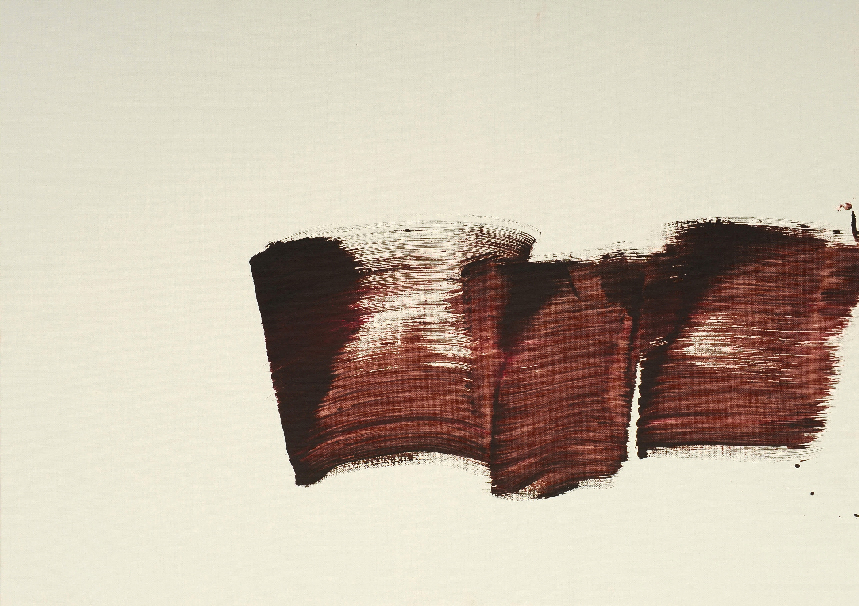
Park Daa Won strokes her brush without reserve at a decisive moment allowing for no compromise. Her recent series <Now Here> obviously suggests the clues about what she has actually continued to pursue. Although it varies - rapid or slow, strong or soft - her brush stroke or her implicit display of power is very bold fundamentally. Here, no phenomenal world is hinted, and no world of the objects is not implicit in terms of the form organic or inorganic. So to speak, it is a kind of abstraction. Anyway, we need to make it clear here. That is, we can hardly approach her painting from the perspective of the abstraction in general. In her abstract paintings which cannot but be understood by intuition are contained her thought and meditation on universe and herself, nature and herself, or other people and herself. Thus, assuming that each of her abstract canvases has contained the figurative world she has long been concerned with in any way, we cannot but approach her paintings differently. We even are tense unconsciously, not knowing when a line or dot appears to imply such figurative world. Namely, it can be said that some situation that cannot be defined conclusively is always contained in her canvas. So, if we assume that Park Daa Won's <Now Here> series feature a space of moment when universe or nature or other people meet us, we will be pleased to see her paintings, while understanding her world of art naturally. In other words, we need to mobilize our intuition rather than logic to approach her paintings more effectively and earlier.

PARK DAA WON / Now here
Needless to say, such level of her artistic performance requires long hard work. Then, let's review her works again. We can see dots and lines standing freely on her canvas. In addition, we can see not only the background canvas with wide margins but also the spaces at certain interval between dots or between dot and line. That is, we can find on her canvas the breathing chasms or some invisible spaces of development like the wave of light or the resonance of rhythm. In short, we can see the spaces as can be interpreted in such a way.
In overall terms, it is not that Park Daa Won's works are planned a priori or intended for some formative configuration but that some coincidental brush touches aim at some unique forms enabled necessarily by sort of spirituality. For example, such gestures as a hot calligraphic abstraction or a strong single brush stroke is freely expressed on her canvas, while a cool control acts thereupon. Namely, contradicting attributes of the formative elements get together in the same space. Coexistence of accidentality and necessity is combined with simultaneous action of freedom and control to activate the canvas, thereby escalating the tension on the entire canvas. Here, we can know how fiercely the artist manages and controls her canvas.
All in all, her canvas is full of the free expression, connoting the methodology of controlling the expression to enhance vitality ironically, and the resultant effect is a dramatically heightened tension on the canvas with free breathing, wave and rhythm converted into energy. Thus, her canvas is both soft and intense, both free and controlled, both slow and rapid, and both void and full. Such opposing formative actions are uniquely supported by a formative theory, which may be quite idiosyncratic. Such idiosyncrasy forms the ground for her art of painting.
Furthermore, what we should not forget here is that her painting is centered about a furnace or her state of mind thinking of, agonizing over, meditating on our human beings and life and the phenomenon of nature and universe. Here, the artist is the subject of such mental working as well as the object thereof. The subject having such a state of mind becomes a truth seeker calming down herself before undertaking her painting work, being prepared for her artistic enterprise. Her art works will be completed through such extraordinary modus vivendi and artistic endeavor. The exemplary model can be found in her <Now Here> series worked out for 2 years. So to speak, these series have survived from her mental struggle.
2
The agony over our human life and existence has been inevitable since human beings began to live a social life. If extreme, the conception resulting from such agony and nihilism thereof might end up with the abandonment of life. Otherwise, our human beings tend to adopt an affirmative and positive way of life, being determined to win over the life. How and in what ways are the artists too sensitive to everything making their life their own one? In case of Park Das Won who perceives that her work is "a course of filtering herself," two aspects seem to act here. One is her inborn temperament, and the other is the background of her growth.
The simple and neat tendency inherent in her works are attributable to her inborn temperament. Namely, when we try to find the ground for the spirituality of her works, we will be reminiscent of her inborn temperament. In this context, Park Daa Won seems to have a very strong intuition. In addition, she seems to have a very strong pride like many other artists. Indeed, every human being is born to believe in his or her own mission or role, and therefore, everybody must respect, value and love himself or herself. As a result, he or she might be too proud or self-conceived, but such problem might well be resolved through stern cultivation of mind-set.
Dansaekhwa with PARK DAA WON
Now Here in Blue
As for Park Daa Won, she seems to do well to convert the negative aspects into some positive ones and treat her emotions as wisely as those who have a strong will to surmount any difficulty in their way. She seems to be intelligent and smart that much. The people who know well about her remind me of such personality of hers. In general, as people live their life, they will be aware of the agony accompanied by the human life, and then, they will suffer from the distracting thoughts caused by the agony of life, and after all, they will be awakened of the meaning of their life. Then, they will feel happy and pleasant for the world and thereupon, they will open their mind wide enough to have their spirituality enlightened. Then, their self-esteem will be enhanced.
When she does her work, Park Daa Won begins to fight herself to regain her self-esteem. In this course, she cultivates her mental power, and ultimately, her mental power turns into an internal power driving her to some simple and clear attitude toward arts. Such attitude must be different from other artists'. It is not toward the canvas work for the composition and perfection of some forms but involves some bold brush strokes visualizing her internal world of arts on the canvas.
Dansaekhwa with PARK DAA WON
Now Here in Blue
Artist Park Daa Won was born in Daegu. She studied fine art at Yeungnam University. The family environment wherein she grew up seems to have nourished the smart kid adequately. Her parents who were well versed in both Oriental and Western fine art collected a variety of art works including calligraphic works and fine art books. Such artistic family environment must not have been surprising to her; it was deemed an ordinary life for her. In a nutshell, her family background couldn't be more adequate for her to develop her artistic sense and potential, which must be very fortunate for her. Besides, her mother endeavored much to have her learn about the basics of the calligraphy; she did not spare money to provide her gifted daughter with the expensive quality Chinese drawing paper. At that time, Seokje Suh Byoung Oh, Jukrong Suh Dong Gyun and other famous local calligraphic artists were in their heyday, which means that she grew up in a good artistic environment. She must have been impressed with their works, though unconsciously. When she was a freshwoman at Yeungnam University, she happened to review Chusa Kim Jeong Hee's <Sehando> (A Cold Winter View) only to be much impressed with the calligraphic virtuoso's masterpiece. Such impression would linger long thereafter. It was neither simple sympathy nor move but a trembling spiritual sympathy. Park Da Won who was even shocked or terrified by Chusa's lines would forget about the paper work with her memory of the thin Chinese drawing paper being dimmed.
Dansaekhwa with PARK DAA WON
THE PAGE GALLERY
Later, Park Daa Won would begin to do the canvas work. Then, she would be reminded and aware slowly of her fingertip experience and her teacher's admonition during her childhood that "Lines should be drawn in mind." That a wide space and lines are revived on her canvas may well be very natural in a sense. Among her earlier realism paintings, some show a surrealistic tendency, which must also be very natural, considering her artistic background as such. And such tendency must be noteworthy. After all, the dimension she has reached after the decade-long trials and errors is her own style featuring her unique methods and forms. It is a new meaning attached to the relationships among calligraphic dots, lines and spaces.
3
The symptoms toward a new century, which began to emerge since the late 1990s, have tilted our mind in both optimistic and pessimistic directions. The trust of the endless scientific and technological development is unprecedented in the human history, presenting a rosy future for a more affluent human life. On the other hand, we live in an age of uncertainty, not being able to predict our future. Thus, our helpless human beings are attracted again to the fortune-telling superstition which we pushed aside long ago. The number of our contemporary men who regard other objects than the talismans as some spiritual things protecting them increases, according to the statistics. Moreover, the financial economy is being more and more globalized, while the waves of globalization demolish the borders among the sectors of life. On the other hand, the local cultures are being globalized, while the world is being divided among the blocks. In this age of chaos, local accidents or events are known real-time through news media, affecting our life instantly.

As individuals living in this age of uncertainty and rapid changes are shocked frequently by unexpected accidents or event, being very vulnerable to them, they tend to long for their own internal world to regain a peaceful state of mind. The speculation and meditation on the painful human souls, which were the primary turfs for philosophers, thinkers and religious leaders, have now become the major concerns of the ordinary people in their everyday life. The human dignity being driving into a corner are being diminished. 'Salvation of the human soul.' This phrase which could be found on monks' manuscripts during the Medieval Age in the West is now being known to everybody's lips regardless religious men or not. Such current situation urges the artists to reconsider about their artistic behaviors and the functions of arts, which must be a request from today's world.
PARK DAA WON /Now Here -Becoming
Here, artists' additional roles requested primarily seem to be consolation and therapy. Namely, arts have additional functions: consolation and therapy. Hence, such catch-phrases as 'recovery of human love,' 'creation of a good neighborhood,' 'dignity of life' and the like are being championed. At this juncture of time, however, we cannot but face the irony that a life should be sacrificed for the survival of other life. In particular, animals and plants should be sacrificed for the human life, and therefore, we human beings have long felt a compassion for them. The profound religious thoughts have focused on such dilemma of life conditions but we can hardly see such dilemma resolved.
NAM JUNE BALK & PARK DAA WON
백남준& 박다원 /
The belief that artists can importantly communicate, sympathize and share with others through their artistic expressions to console and treat them is widely spread today in the artists' community. From such perspective, Park Daa Won's works seem to vary enough to resonate softly with the world, embracing other people; we can know such power of her works intuitively. If we review her approach to arts, we can know that it is a unique method of creation being established in her mind. So, as mentioned before, she is confident that her works will filter out the people. Those with a clean soul. Who else are the valuable audience for her? As the surrealist Andre Breton once said, what he really wanted for his ideology was the Oriental abstraction. If our Korean contemporary artist Park Daa Won could reconfirm Breton's statement in her ultra-realistic or surrealistic works, we may have to reorganize the topographic map for the Korean contemporary fine art.
.JPG)