
PARK DAA WON -Now here in Blue
Art of Tansaekhwa / By Eun young Ahn(Austrian Art critic)
Daa Won Park was born in
Daegu
and studied painting at the College of Design and Art, Yeungnam University. Park is a petite woman with a gorgeous girly
smile. In contrast to her feminine
physical appearance, her work is intriguingly masculine. The masculinity of her recent body of work
such as Now Here In
Blue” and “Now
Here-Becoming” series is manifested in the boldness, dynamics, vigour
and energy which are expressed by her confident brushwork, as well as the
carefully staged tensions between the painted image and empty spaces and the
mobile and static. This masculinity is
perhaps derived from her aesthetic foundation largely shaped through her early
childhood exposure to the Korean literati painting (‘Muninhwa’ in
Korean and ‘Wenrenzhihua’
in Chinese), which was traditionally predominately practiced by men, especially
scholar-gentlemen during the Joseon Dynasty (1392-1910). Growing up with a mother who ran a gallery,
Park was extremely fortunate to see the original works of the last eminent
Joseon literati masters like Byeong O Seo (1862-1935) at very early age. In her first year at university, she had also
a rare chance to see the original painting of “A Wintry
Scene” (Sehando) is
held in a private collection. Wintry Scene
is one of the best known works by by Jeong Hui Kim (1786-1857), who was a
powerful scholar-official, an influential art critic and connoisseur, an
acclaimed calligrapher and importantly, the most prominent literati painter of
the late Joseon period. Kim painted this
piece during his exile (1840-1848) on Cheju Island. The deliberately sketchy wintry scene,
thereby creating an austere atmosphere, is designed to express the artist’s
lonely inner self and his integrity. Park’s “Now Here In
Blue” and “Now
Here-Becoming” series, despite of their contemporary medium and
idioms, are connected to the essence of the Korean literati tradition
exemplified by Kim.

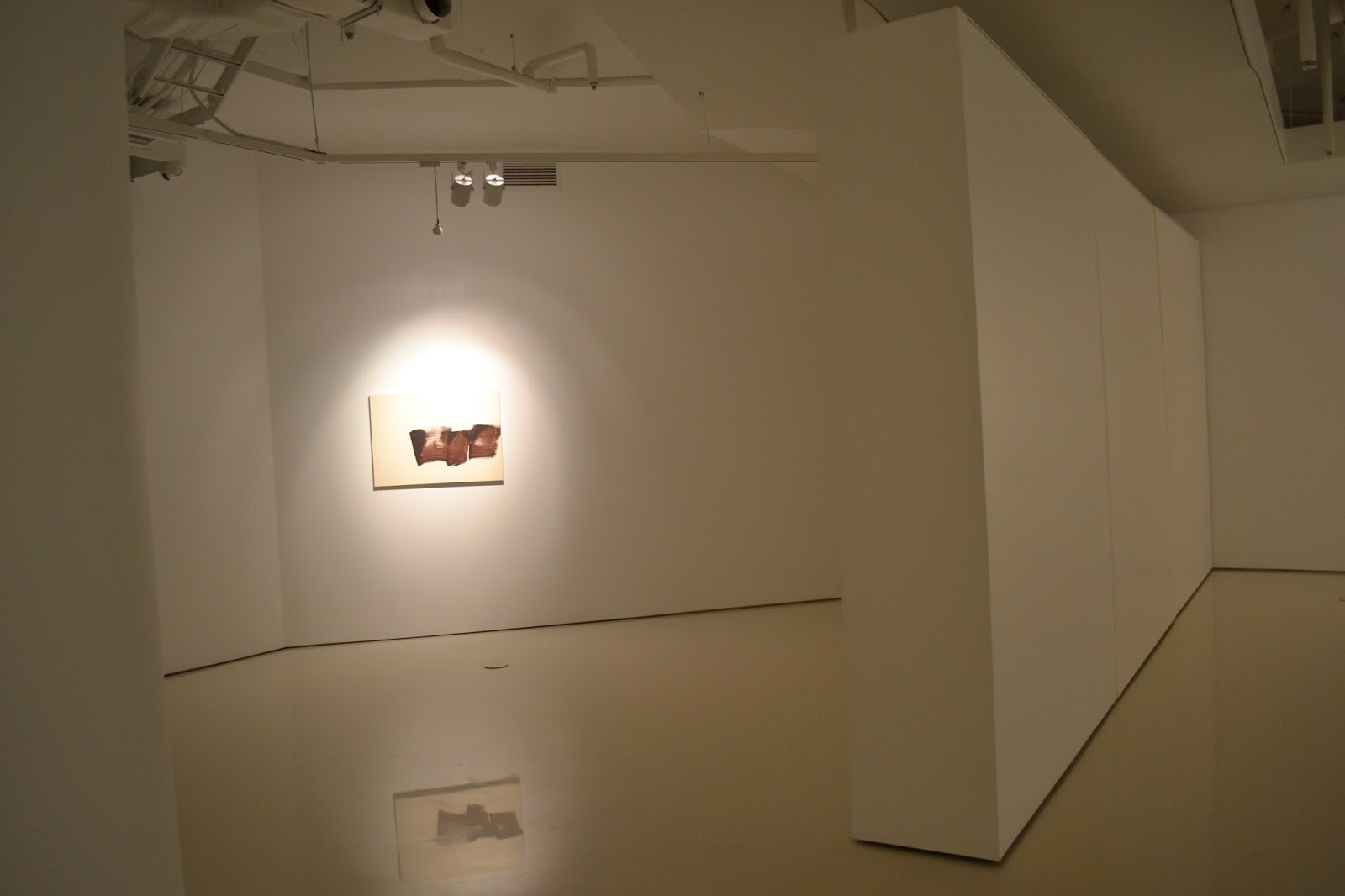
Now Here i
now here In blue 2010
now here In blue 2010
Park is, of course, not
the only contemporary Korean artist who rediscovered the contemporary relevance
of the calligraphy and brush-and-ink painting originated in ancient China and
practiced widely in East Asia. Not only
Korean artists but also other Asian artists like Zao Wou-Ki (1920 –2013), as
well as Western artists such as the French Art Informel painter Georges Mathieu
(1921 –2012) and the American Abstract Expressionist Franz Kline (1910–1962),
found inspiration in the tradition of East Asian calligraphy and ink painting in
their search for an authentic way to express their emotions, inner world,
psychological sates and spirituality.
According to the East Asian literati painting theory, first formulated in
the 11th century by Su Shih (1036-1101), a Northern Sung painter and
calligrapher, the distinctive use of an individual artist’s brushwork could and
should reveal chi, the
spirit of Nature or the spirit of the artist herself or himself. Park’s “Now Here In
Blue” and “Now
Here-Becoming” series are a contemporary reinterpretation of this
theory. Each piece of these series
captures the arrested momentum of the varied breath, rhythmic energy flow,
emotion, spiritual strength and psychological force of the artist, which is
meant to animate or be re-produced in the mind of the viewer. To arrive at this state, Park has refined
necessary skills and techniques. Her
seemingly spontaneous and ‘natural’ brushwork is in fact a result of numerous
rehearsals of swiftly making an image without drawing over the same line
twice. Before the performance of
painting she meditates, and thus she has a clear vision of the images she is
about to create. Through this diligent
practise regime, she has achieved a fine balance between the opposition of
control and freedom or dynamism in the “Now Here In
Blue” and “Now
Here-Becoming” series.


Art of Dansaekhwa / PARK DAA WON
Now here -becoming

Art of Dansaekhwa / PARK DAA WON

Art of Tansaekhwa / PARK DAA WON

Art of Dansaekhwa PARK DAA WON

Art of Tansaekhwa PARK DAA WON
Now here-becoming

Art of Dansaekhwa PARK DAA WON

Art of Tansaekhwa PARK DAA WON

Art of Dansaekhwa PARK DAA WON

Art of Tansaekhwa PARK DAA WON
Wave- now here

Art of Dansaekhwa PARK DAA WON
Art of Dansaekhwa PARK DAA WON

Art of Dansaekhwa PARK DAA WON

Art of Tansaekhwa PARK DAA WON

Art of Dansaekhwa PARK DAA WON


Art of Dansaekhwa PARK DAA WON


